
Automated Invoice Field Extraction & Table Parsing for Retail & Procurement
Technical review of a layout-aware document vision pipeline that processes B2B commercial invoices, extracts structured key-value entities, parses line-item tables, and reconciles totals with enterprise ERP compatibility.
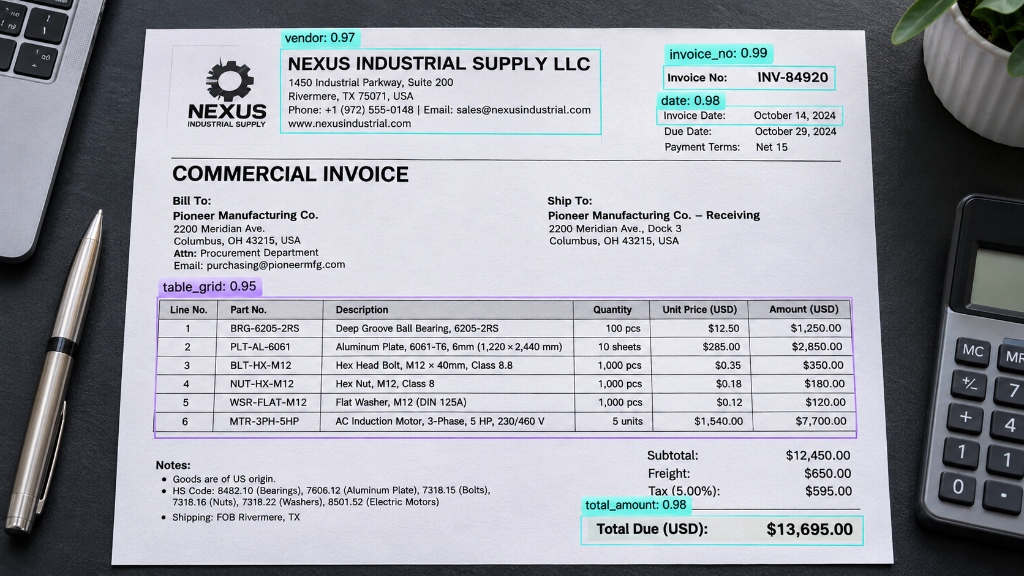
Accounts Payable Bottlenecks in Retail & Supply Chains
Procurement teams process hundreds of supplier invoices weekly, creating operational friction when reliant on manual entry or brittle template OCR.
Manual Line-Item Re-Keying
Manually entering complex invoices with 6 to 50 individual part numbers, unit prices, and line amounts into ERP systems takes 8–15 minutes per document and introduces transposition errors.
Template Fragility in Legacy OCR
Traditional coordinate-based OCR fails whenever a vendor updates their invoice layout, changes margins, wraps descriptions across two lines, or shifts tax totals to another section.
Confidential Procurement Data
Invoices contain proprietary wholesale pricing, supplier terms, and banking remittance instructions that cannot be exposed to multi-tenant public AI models with ambiguous data retention policies.
Document Vision Processing Pipeline
Multi-modal architecture combining 2D spatial layout coordinates with text embeddings for deterministic extraction.
Document Ingestion
PDF or high-resolution image is normalized, deskewed, and pre-processed to ensure optimal optical text clarity.
2D Layout Tokenization
Layout-aware vision model maps spatial 2D coordinates alongside character tokens, understanding key-value proximity and hierarchy.
Table & Entity Extraction
Named entities (Vendor, Invoice #, Date, Total) and tabular grid line items are segmented and extracted into structured objects.
Mathematical Validation
Automated arithmetic checks verify that line item sums plus freight and tax equal the extracted total before pushing to ERP APIs.
Representative Model Evaluation
Benchmark observations across unstructured and semi-structured commercial invoice validation datasets.
Field-Level Accuracy
Accurate extraction across vendor blocks, invoice identifiers, and total payable amounts.
Typical Confidence Scores
Observed confidence range for clear, printed standard commercial invoice documents.
End-to-End Latency / Page
Complete ingestion, optical OCR, layout parsing, and table structuring per document page.
On-Premise / Private VPC
Zero data retention; proprietary pricing and vendor contracts remain within your corporate firewall.
Explore Document AI for Your Organization
We evaluate your sample invoice documents, table structures, and target ERP integration endpoints to architect an automated extraction pipeline.