
Real-Time PPE Compliance & Heavy Machinery Geofence Monitoring on Job Sites
Technical review of an edge-deployed computer vision pipeline that automatically verifies personal protective equipment (hard hats, safety vests) and monitors spatial perimeter boundaries around active earthmoving equipment.
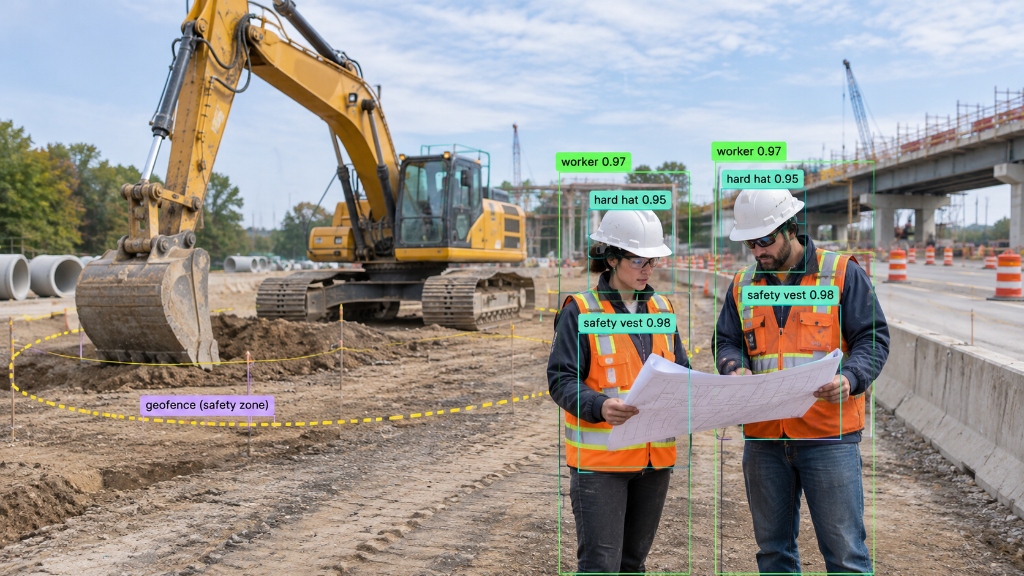
Construction Site Hazard Management
Construction sites are continuously changing environments where ground personnel and heavy earthmoving machinery operate in close proximity.
Machinery Blind Spots & Swing Radius
Excavator and crane operators have substantial physical blind spots. Ground crews focused on blueprints or site grading can inadvertently step into active machinery swing perimeters.
Inconsistent PPE Enforcement
Manual safety audits capture only periodic snapshots. Temporary removal of hard hats in warm weather or unfastened high-vis vests frequently goes undetected until an accident occurs.
Bandwidth & Cellular Limitations
Remote job sites often operate over 4G/5G mobile gateways. Streaming high-resolution feeds to cloud AI platforms consumes prohibitive bandwidth and introduces latency delays.
On-Site Edge Safety Workflow
Decentralized edge architecture designed for outdoor environmental tolerance and autonomous local hazard alerting.
RTSP Stream Capture
Weatherproof IP cameras positioned on perimeter poles or temporary towers pull H.264/H.265 video feeds over local Ethernet or Wi-Fi bridges.
Multi-Class Localization
Quantized object detection model concurrently identifies worker silhouettes, safety helmets, and reflective vests under changing outdoor illumination.
Hierarchical PPE Binding
Spatial overlap checks link headgear and torso vests directly to the specific worker coordinate, ensuring each person is individually evaluated.
Virtual Geofencing & Alerts
Polygon boundaries around machinery check for personnel ingress. Breaches trigger on-site audible sirens or automated supervisory log entries.
Representative Model Evaluation
Benchmark observations across outdoor construction safety validation datasets.
mAP@0.5 Benchmark
Mean average precision across workers, hard hats, and reflective vests in outdoor field conditions.
Typical Confidence Scores
Observed confidence range for clear, unoccluded personnel and protective gear.
Edge Inference Latency
Evaluation latency on ruggedized on-site edge microcomputers running TensorRT.
On-Site Edge Execution
Zero continuous cloud video streaming; functions autonomously during intermittent cellular access.
Explore Computer Vision for Job Site Safety
We assess your site layout, camera viewing angles, hazardous machinery zones, and local power/connectivity constraints to architect a tailored safety system.